Pages

Showing posts with label exercise evidence life extension. Show all posts

Sunday, 8 July 2018

reposted from:
crabsallover highlightskey pointscomments / links.

At the UK PintofScience.co.uk in Bournemouth on 15th May 2018, Dr. Susan Dewhurst (Senior Lecturer at Bournemouth University) presented the association between Leasure Time Physical Activity (LTPA) and mortality.


After the talk Susan shared a reference with me:


Arem H, Moore SC, Patel A, et al. Leisure Time Physical Activity and Mortality: A Detailed Pooled Analysis of the Dose-Response Relationship. JAMA Intern Med. 2015;175(6):959–967. doi:10.1001/jamainternmed.2015.0533.
website accessed 8th July 2018.

It seems any level of exercise is better than none! (see figure above). Metabolic Equivalent (MET) 7.5 equates to 75 minutes per week of vigorous exercise or 150 minutes per week of moderate exercise, the mortality rate is 20% (0.8) lower than those who take no exercise. Doubling this exercise (15 MET) reduces mortality rate by 31% (0.69) compared to those who don't exercise.

7500 steps a day

"Walking 10,000 steps a day is not an official recommendation from the Centers for Disease Control and Prevention. Instead, the agency recommends adults engage in 150 minutes of moderate activity a week, such as brisk walking. To meet the CDC's recommendation, you need to walk about 7,000 to 8,000 steps a day, Tudor-Locke said." Source: LiveScience.
It seems that to achieve 15 MET you need to walk 14,000 to 16,000 steps a day (150 minutes per week of vigorous exercise or 300 minutes per week of moderate exercise).


Tuesday, 31 August 2010

Brisk walks ‘could prevent 10,000 breast and bowel cancers’

source: Times
About 10,000 cases of breast and bowel cancer could be prevented every year in Britain if people quickened their walking pace and became more physically active, researchers say. Scientists believe that up to 4,600 bowel cancer cases and about 5,500 breast cancer cases could be avoided by more brisk walking and other forms of moderate activity, which causes the heart to beat faster and increases breathing.

Physical activity is also known to reduce the risk of endometrial cancer, which affects the womb, as well as helping people trim waistlines. Being overweight or obese is a known risk factor for several types of cancer, as well as heart disease and type 2 diabetes, according to the World Cancer Research Fund (WCRF). 

Rachel Thompson, deputy head of science for the fund, said: “You don’t have to go to the gym every day to benefit. “You can reduce your cancer risk just by making small changes and this is highlighted by the fact that so many cancer cases could be prevented through something as simple as brisk walking. “By taking up walking as a hobby or even walking to the shops instead of taking the bus or car, people can make a real difference to their health.” Dr Thompson said that there was “a lot of work to do” in raising awareness because few people were aware of the link between exercise and cancer risk. Each year, about 13,000 people in Britain die of breast cancer and 16,000 of bowel cancer. 

The WCRF recommends being physically active for at least half an hour a day. However, according to government figures, only 37 per cent of men and 25 per cent of women manage this. 

The latest figures came from a WCRF report that suggested up to 40 per cent of all cancers could be prevented by adjusting lifestyle factors such as losing weight, cutting down consumption of red meat or alcohol and doing more exercise. 

Previously studies have shown that moderate exercise can have a protective effect against breast and bowel cancer and can reduce the risk of lung cancer by as much as 40 per cent.

Monday, 10 November 2008

healthy people avoid high blood pressure & control weight by short bursts of high intensity exercise

source: http://www.bpassoc.org.uk/mediacentre/Bloodpressurenews/Stoppinghighbloodpressureischildsplay

Preventing high blood pressure is child's play
04/11/2008

Research from Wales suggests that healthy people may be able to avoid high blood pressure, and control their weight, by short bursts of high intensity exercise - much like the way children play in a playground. For example,

the researchers believe that six short, sharp sprints of 30 seconds three times a week could be as beneficial as jogging or cycling for 45 minutes five times a week.

However, high intensity activity is not recommended for people with high blood pressure because it may raise their blood pressure to a dangerously high level. If you have high blood pressure and want to lower it, 30 minutes of moderate intensity exercises such as cycling, swimming or brisk walking five times a week is still the best choice.

Key points

Key points about exercise and high blood pressure:

  • Being active helps to keep our heart and arteries flexible and efficient - lowering our blood pressure and our risk of a heart attack or stroke
  • The UK Government recommends that everyone takes 30 minutes of moderate intensity exercise (dancing, digging or brisk housework) five times a week to look after their heart
  • This research suggests that people who do not have high blood pressure could benefit from short, sharp bursts of high intensity activity
  • People who have high blood pressure should avoid high intensity exercises because it may raise their blood pressure to dangerous high levels
  • To lower pre-existing high blood pressure, following the Government's advice is the best established option

What did the research find?

Because only 29% of adults in Wales reach the Government's advice of 30 minutes of moderate intensity exercise five times a week, researchers wanted to see if other, quicker forms of exercise could be as beneficial.

The scientists, from the University of Glamorgan, looked at people's exercise patterns over a number of years and compared short high-intensity sprints to moderate intensity activities such as jogging or cycling.

They found that healthy people who sprinted had the same health benefits as those undertaking endurance activities.

According to their study,

the researchers believe that six short sprints of 30-60 metres (that last up to 30 seconds) with a four minute rest period in between each sprint, is beneficial.

What do the findings mean?

If you do not have high blood pressure and wish to prevent it:
This research suggests that building in short, high-intensity activities and exercises into your day may help to keep your weight down and keep your arteries and heart in good condition.

If you have high blood pressure and wish to lower it:
This research may not be useful for you. High-intensity exercises will raise your already-raised blood pressure even higher and this may be dangerous for you. For this reason, it would be best to continue to follow the UK Government's advice of 30 minutes of moderate-intensity exercise five times a week to benefit your heart and lower your blood pressure.

More from BBC Wales

Regret original peer reviewed research not found by crabsallover.


Thursday, 9 October 2008

Physical Activity Recommendations and Decreased Risk of Mortality

source: http://archinte.ama-assn.org/cgi/content/abstract/167/22/2453
Background
Whether national physical activity recommendations are related to mortality benefit is incompletely understood.

Methods .... examined physical activity guidelines in relation to mortality among women and men aged 50 to 71 years.

Results .... During follow up 7900 participants died. Compared with being inactive, achievement of activity levels that approximate the recommendations for moderate activity (at least 30 minutes on most days of the week) or vigorous exercise (at least 20 minutes 3 times per week) was associated with a 27% and 32% decreased mortality risk, respectively. Physical activity reflective of meeting both recommendations was related to substantially decreased mortality risk overall. Engaging in physical activity at less than recommended levels was also related to reduced mortality risk.

Conclusions Following physical activity guidelines is associated with lower risk of death. Mortality benefit may also be achieved by engaging in less than recommended activity levels.

Tuesday, 7 October 2008

A Daily Workout Could Add 4 Years to Life, by Oscar Franco


I googled: exercise "live longer" and No 1 on the list of a million was this article from Washington Post.

From research in 2005 in Archives of Internal Medicine , Walking or moderate physical activity added an extra 1.3 years life exension compared to people with low levels of physical activity. Running or high physical activity gave 3.7 years life extension.

"Moderate and high physical activity levels led to 1.3 and 3.7 years more in total life expectancy and 1.1 and 3.2 more years lived without cardiovascular disease, respectively, for men aged 50 years or older compared with those who maintained a low physical activity level. For women the differences were 1.5 and 3.5 years in total life expectancy and 1.3 and 3.3 more years lived free of cardiovascular disease, respectively."

In the Methods ASSESSMENT OF PHYSICAL ACTIVITY section, they define moderate exercise as having 1-3 weighted hours /day (equiv to 12-36 mins run) more than low activity level, and high activity is >3 weighted (equiv.to >36 minutes run) hours /day physical activity level. This assumes run is x5 factor over sleeping.

NB. For 50 year or older men running 30 minutes a day, 5 days a week is 3 months total exercise over 20 years for a gain of 3.7 years life.

By Rob Stein
Washington Post Staff Writer
Tuesday, November 15, 2005; Page A01

Sorry, couch potatoes -- the verdict is in: People who exercise regularly really do live longer.

In fact,
people who get a good workout almost daily can add nearly four years to their life spans, according to the first study to quantify the impact of physical activity this way.
The researchers looked at records of more than 5,000 middle-aged and elderly Americans and found that those who had moderate to high levels of activity lived 1.3 to 3.7 years longer than those who got little exercise, largely because they put off developing heart disease -- the nation's leading killer. Men and women benefited about equally.

"This shows that physical activity really does make a difference -- not only for how long you live but for how long you live a healthy life," said Oscar H. Franco of the Erasmus M.C. University Medical Center in Rotterdam, who led the study, published yesterday in the Archives of Internal Medicine. "Being more physically active can give you more time."

Previous studies have found that being physically active has a host of health benefits. It reduces the risk of being overweight and of developing many illnesses, improves overall quality of life, and lowers the mortality rate. But the new study is the first to directly calculate the effect on how long people live.

"This should encourage people to be more active -- to take a more active role in their own health and not just sit and wait for a pill to prevent this or that or save your life," Franco said.

Franco and his colleagues
analyzed data from the Framingham Heart Study
, a well-known research project that has followed 5,209 residents of a Massachusetts town for more than 40 years, collecting detailed information about their lifestyles and health.

The researchers calculated the effects of low, moderate or high levels of physical activity on life span, accounting for the possible effects of factors such as age, sex, education, and whether they smoked or had serious health problems.

People who engaged in moderate activity -- the equivalent of walking for 30 minutes a day for five days a week -- lived about 1.3 to 1.5 years longer than those who were less active. Those who took on more intense exercise -- the equivalent of running half an hour a day five days every week -- extended their lives by about 3.5 to 3.7 years, the researchers found.
The findings show that even for people who are already middle-aged, exercising more can add years to their lives, Franco said.

"This shows it's never too late to start following a healthy lifestyle. It's never too late to start exercising," Franco said. "For example, instead of taking your car to your office, why don't you take your bike or walk? Physical activity is very important for a healthy lifestyle."

Other experts said the study was consistent with the growing evidence that exercising on a regular basis is one of the most important things people can do for their health

"At the end of the day, this is more evidence that the sedentary lifestyle is the most devastating to health, longevity and chronic disease development," said James O. Hill of the University of Colorado at Denver, adding that he hoped it might motivate more people to exercise. "Putting it in terms of life expectancy is something that's relevant to people."

While adding one to four years may not sound like a lot to some people, Franco, Hill and others said exercising regularly also enables people to live healthier lives, free from a host of chronic illnesses that can make it hard for people to enjoy their later years.
In addition, recent studies have also found that exercise has payoffs for the mind, too. It has been shown to improve overall well-being, reduce stress and depression, and cut the risk of Alzheimer's and other forms of dementia, several experts said.
"The benefits of physical activity extend well beyond the effects on longevity,"
said JoAnn E. Manson of Harvard's Brigham and Women's Hospital in Boston.

The trouble is, many people seem to ignore the evidence, government recommendations and public health campaigns to be physically active.

Most Americans still fail to exercise regularly, and the number who exercise in their leisure time has been dropping, according to a recent report from the Centers for Disease Control and Prevention.

Franco and others noted that this and other studies show that people do not have to be exercise fanatics to reap the benefits. Adding just a little activity to the daily routine can have major benefits.

"What we're talking about is small changes," Hill said.
"We're telling people to get out and walk more. Fifteen, 20 or 30 minutes of walking each day is probably enough."

NB. A 2003 BMJ article by Brindle et al suggest the Framingham study overestimates risk in UK populations.

Thursday, 2 October 2008

Women should walk - evidence for exercise benefits

reposted from: Bandolier - full article posted below, unedited. "The bottom line is that women who walk briskly or exercise vigorously for three hours a week or more can reduce their risk of heart disease."


Women should walk


Study
Outcomes
Results
Comment
Bandolier is keen on evidence on healthy living. One of the excellent sources of evidence is the US nurses' health study, started in 1976, when about 122,000 female nurses in the 30 to 55 age group were enrolled. Questionnaires were filled in then, and other information was collected in 1980, '82, '86, '88 and 1992. This information showed the relationship between folate and multivitamin use and reduced colon cancer incidence ( Bandolier 60 ).

A new analysis [1] sought to pin down the relationship between coronary heart disease and exercise in women. In Japanese men, a study showed that regular walking decreased mortality ( Bandolier 50 ).

Study


Detailed information on physical activity was first collected in 1986 and updated in 1988 and 1992. This included various forms of vigorous and non-vigorous exercise, plus a walking history that included their walking pace: easy or casual (less than 2 mph), average (2.0 to 2.9 mph) or brisk (more than 3 mph) [note that 1 mph = 1.6 kph]. A weekly metabolic-equivalent (MET) was calculated for the various forms of activity. Total MET hours per week was then calculated.

Activity MET per hour
Vigorous more than 6
Nonvigorous less than 6
Walking 2.5 to 4.5, depending on pace
a MET is the caloric need per Kg per hour of activity divided by the caloric need per Kg at rest

Outcomes


The primary endpoint was coronary events defined as nonfatal myocardial infarction or death due to coronary disease occurring after 1986 and before mid-1994. There were 645 coronary events. The physical activity assessed in 1986 was used as the baseline.

Results


Information was grouped into quintiles of MET hours per week, with about 14,000 to 15,000 women in each quintile. The distribution of physical activity between the quintiles is shown in Figure 1. The mean of 15 MET hours per week in quintile 4, for instance, implies that a woman would walk briskly for about four hours per week. Women in the high MET quintiles were less likely to smoke, were leaner and had lower prevalences of diabetes, hypertension and hypercholesterolaemia than those in the lowest quintiles.

Figure 1: MET hours per week for each quintile


When adjustment was made for these factors there remained a significant association between higher levels of total physical activity and reduced risk of a coronary event (Figure 2). There was a 34% reduced risk for the highest total activity quintile.

Figure 2: Relative risk of coronary event for each quintile

Significant reduction in quintiles 4 and 5

In women who took no vigorous exercise, brisk walking had a similar effect on reducing the risk of a coronary event (Figure 3). Using women who walked at a casual or easy pace as a baseline, women who walked briskly reduced their risk by 36%. Compared with sedentary women, women who walked briskly for 1 to 3 hours a week had a risk reduced by 30% (95% CI 5 to 49%) after allowing for other factors.

Figure 3: Relative risk of coronary event by walking pace for women who did not take vigorous exercise


Comment


This is another study linking increased physical activity to better health. Importantly this study is one of the biggest to examine the effects of exercise in women. The bottom line is that women who walk briskly or exercise vigorously for three hours a week or more can reduce their risk of heart disease. ImpAct 3 examined a visionary scheme for prescribing walking exercise.

Bandolier 50 had reports of walking reducing coronary and all cause mortality in retired Japanese men in Hawaii, and of exercise reducing death rates in a Finnish twin study. The benefits of moderate exercise have been known for some time, and the evidence continues to accumulate. The size of the effects continues to impress, and just shows that evidence-based healthy living is something upon which we should concentrate more.

Reference:

  1. JE Manson et al. A prospective study of walking as compared with vigorous exercise in the prevention of coronary heart disease in women. New England Journal of Medicine 1999 341: 650-8.

Can 15 minutes exercise a day give an extra 3 hours a day to your life?

source: Hacker's Diet, Exercise 

Where is the evidence that doing 15 minutes exercise a day will increase life span by an extra 3 hours a day? Via NHS Direct gave a link to Bandolier

Bandolier say "This site is for those of us who want to know that getting breathless is a good thing, but need assurance or reassurance that it has powerful benefits for our health now and in the future."

What, Me Exercise?

Those who do not find time for exercise now will have to find time for illness.
—The Earl of Derby, 1873
Don't kid yourself into thinking that exercise, by itself, will make you lose weight. Consider the following activities, and the number of calories an average person burns per hour in each.


Activity Calories/hour
Walking 300
Bicycling 300
Aerobics 400
Swimming 400
Tennis 500
Basketball 500
Jogging 700
Compare those numbers, remembering that they're for a full hour spent nonstop in the exercise, with the calories in the following food items:


Tasty Treat Calories
Peanut butter sandwich 275
Pizza (3 slices) 500
Big Mac 560
Clearly, even an hour a day of exercise doesn't account for much food. And what's the likelihood you'll find the time to spend a full hour, every day, month after month, year after year, doing those exercises?
So, don't exercise to try to burn off calories and lose weight. Unless you're a professional athlete or obsessed with sports, you're not likely to spend enough time exercising strenuously enough to make much of a difference. Exercise will help you lose weight in more subtle ways. Regular exercise increases your rate of metabolism: the number of calories you burn all the time. Plus, for many people, exercise actually reduces appetite.
But these are side effects: hardly reasons to start exercising. The real reasons to exercise are that you'll live longer and feel better. Let's consider the case for exercise from those standpoints.

Living longer

I was never much of a one for sports. Every time I played baseball, I got hit in the mouth with a ball or bat. Whenever I played football, I ended up with a mouthful of mud. Imagine my delight when I discovered that the physical education requirement at my college could be satisfied by playing ping pong or on the rifle range.
After reaching that glorious stage in life when other people couldn't make me do things I'd rather not, the case against exercising seemed straightforward and overwhelmingly persuasive.
  1. Exercising consumed time.
  2. Exercising was not programming.
  3. Therefore, by exercising, less time was available for programming.
I'm a hacker—I like to program! Substitute your own favourite activity for programming and you'll see what I mean. In addition, exercise carried all the unpleasant connotations of high school calisthenics, or the equivalent indignity of more modern, yet equally regimented, forms of workouts.
But is there a flaw in this argument after all? Indeed there is. The premises are correct, but the conclusion doesn't account for the fact that regular exercise will, in all likelihood, allow you to live longer. Let's look at the numbers.
This “Life Extension Worksheet” is provided as an Excel worksheet. You may want to load LIFEXT.XLS and plug in your own numbers to compare with mine. Directions for calculating increased lifespan by hand are given in the Pencil and Paper chapter.
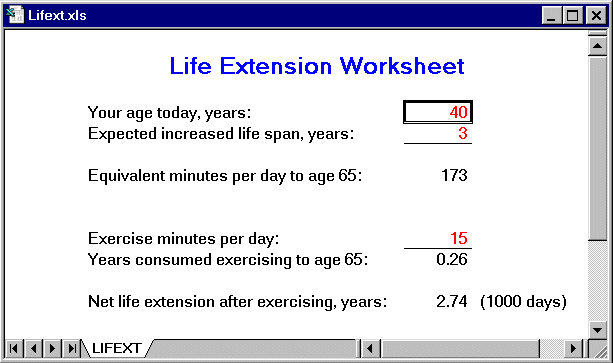
Life Extension Worksheet
So, if you're 40 years old, and you exercise 15 minutes a day from now until you turn 65, you'll have spent a total of about a quarter of a year exercising in those 25 years.
But, if by exercising you manage to live 3 years longer, you're ahead by a total of two and three quarters years by age 65—1000 days. Your increased life span works out to an additional 172 minutes per day from age 40 through 65. Even after spending 15 minutes exercising, the life extension you can expect from getting into shape gives you what amounts to two and half more hours per day to do whatever you enjoy most! Even if you live only one additional year through physical fitness, you'll still end up with 270 more days by exercising.
Of course, we're talking percentages here; you could be run over by a truck tomorrow. But hey, if you're in shape you may dodge that truck!

Feeling better

Exercising not only gives you more time to live, it makes the time you live more enjoyable. You'll feel better, think straighter, sleep more soundly, and have more capacity and endurance for everything you wish to do. How much? It varies from person to person; the only way to experience the benefits is to start an exercise program and see for yourself.
Fortunately, the payoff becomes apparent pretty early-on, particularly in a program like this one where you can always compare your current level of fitness with the much lower levels you strove to master only a few weeks before.
If you don't buy the “feeling better” argument, consider this. Virtually all medical evidence shows that if you don't exercise, you're more likely to suffer a heart attack or, if you're going to have one anyway, to have it earlier in life. Even if you're resolute in believing you won't feel one whit better from exercising, you'll certainly concede that you'll feel a whole lot worse after collapsing to the floor with a coronary. I've no direct experience with this particular unpleasantness from life's menu of surprises, but folks I've talked to who have are unanimous that it's best avoided. Those who dropped dead right away were unavailable for comment.